Camping Gear for Long-Distance Bikepacking
This page contains affiliate links. If you purchase through these links I may earn a small commission at no extra cost to you.
After more than 140,000 km on the bike, I’ve learned that a solid camping system is almost as decisive for tour success as the bike itself.
Weight plays a major role for me, but never at the expense of durability and reliability. I look for gear that offers a smart balance between low weight, robustness, and real-world practicality on multi-month journeys — from high mountains and deserts to tropical climates.
On this page you’ll find my current shelter and sleeping system as well as my cooking setup. Both have proven themselves over many years, are repair-friendly, and optimized for long-distance touring.
Here’s my current long-distance camping setup:
Table of Contents
Shelter & Sleeping Setup
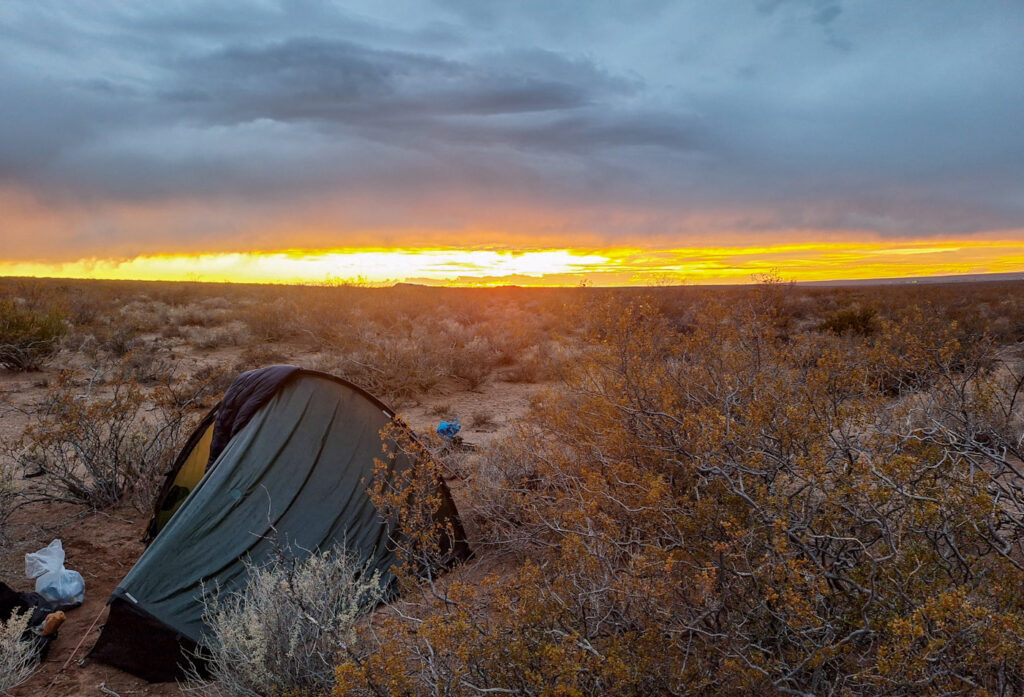
Tent
- Hilleberg Enan with footprint
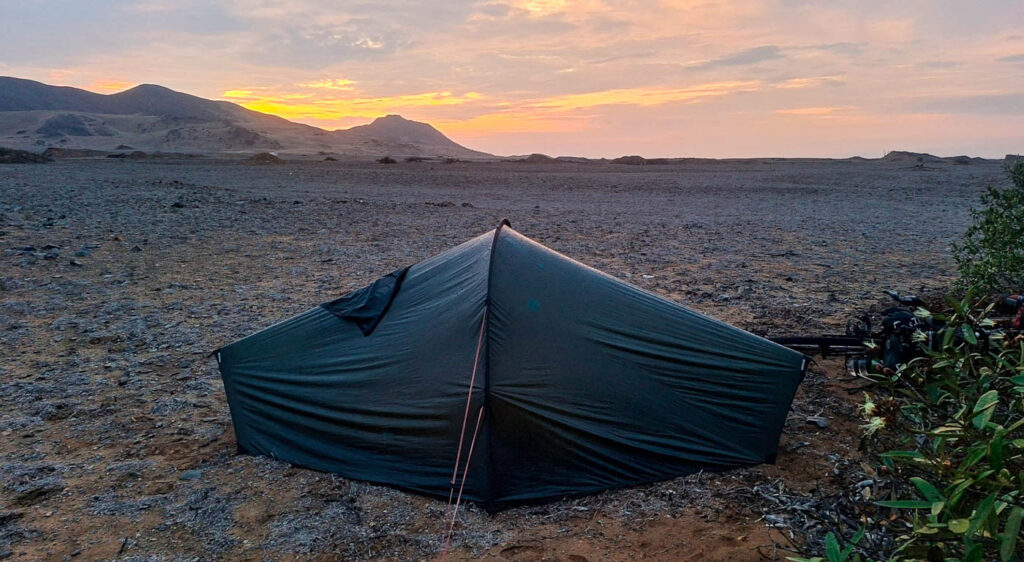
When choosing a tent before my first long tours, my requirements were clear: genuinely lightweight, but without compromising wind stability. Many ultralight options achieve low weight by relying on trekking poles for pitching — which I wanted to avoid entirely. The Enan pitches with its own poles and handles wind exceptionally well for its weight class.
The enclosed porch was another decisive factor. Having a covered vestibule to store bags, wet gear and shoes makes a real difference on a long tour, especially in bad weather.
After years of use across multiple continents it has proven to be the right choice — I have not found a better single-person tent for this style of travel.
Even the best tent eventually shows signs of wear. After enough time on the road, small holes or tears in the fabric are inevitable — regardless of brand or quality. A dedicated post on field repairs and long-term tent maintenance is coming.
Sleeping Pad
- Therm-a-Rest NeoAir XLite
- Additional shortened foam pad
In the ultralight category the NeoAir XLite is a clear choice. No other pad comes close to its R-value at this weight and comfort level.
I used self-inflating pads for years before switching — and the comfort difference is significant. The common argument against air pads, that you have to inflate them manually, never convinced me. A self-inflating pad still needs topping up, and an extra 30 seconds of blowing makes no practical difference.
Long-term durability is the only real concern. Punctures happen eventually, but repairs are straightforward and permanent — the repair kit is included in the box.
The additional shortened foam pad adds redundancy for situations where the NeoAir needs repair and as extra insulation in very cold conditions.
Sleeping Bag
- Mammut Sphere Down Spring (discontinued)
My target was a sleeping bag that keeps me reasonably comfortable down to freezing point — accepting that at those temperatures you sleep in additional layers rather than just the bag alone. Down was the obvious choice given the weight and packed size requirements.
For a setup optimized around weight and packability, it has proven to be a well-balanced long-term choice.
The Mammut Sphere Down Spring has covered a lot of ground since then. After extensive use I had it professionally serviced and topped up with around 50g of additional down fill. The result is a bag that handles nights around -5°C well — not luxuriously warm at that point, but far from freezing. By the end of a cold night comfort has faded, but it remains functional.
Unfortunately this exact model is no longer available. For a comparable alternative I would look for a down sleeping bag in the 500-600g range with a comfort rating around 0°C — Globetrotter carries a good selection.
Cooking Setup
Stove
- Homemade Alcohol Stove
- 550 ml Titanium Pot
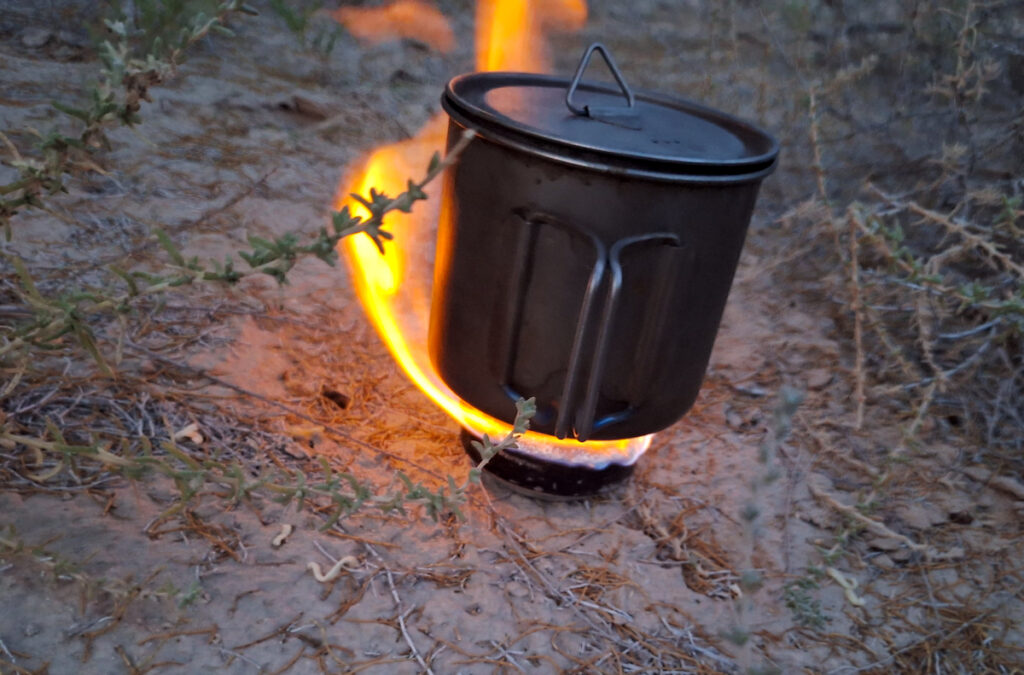
Simple systems often work best over long periods of time.
Alcohol stoves are lightweight, quiet, mechanically simple and easy to maintain almost anywhere in the world.
Read more about alcohol stove in my post: Alcohol Stove Cooking
Water Filter
- Sawyer Squeeze Micro Filter
- Katadyn Micropur Forte Tablets
A water filter is useful to have, but it is not the essential piece of gear many gear lists make it out to be. In practice, tap water is drinkable far more often than commonly suggested — particularly across South America. In remote areas I regularly drink directly from rivers coming out of the mountains, or where the map shows nothing but forest above.
The Sawyer Squeeze Micro covers the most common scenarios well. It filters bacteria and parasites, is light, and screws directly onto a standard bottle if the included bag wears out — which it eventually will. Mine has developed small holes after extended use, but still works fine.
For viruses, Micropur tablets are the better tool. Using both together gives the most complete protection. One exception worth knowing: on the Tibetan Plateau, yak-populated areas can have chlorine-resistant parasites — in that case the filter matters more, not less.
The one thing no filter solves is the absence of water entirely. In desert terrain you simply carry what you need. Where there are people, there is usually water — in truly remote areas with no one around, a clean mountain source is often available anyway.
For shorter trips, a handful of Micropur tablets is often enough. They are significantly smaller and lighter than any mechanical filter — and while the Sawyer Micro is already compact, tablets take up almost no space at all.
Headlamp
- Petzl Bindi
For camping, brightness is not the priority. What matters more is battery life and the availability of a low-power mode — you rarely need to illuminate anything beyond arm’s reach inside or around the tent.
The Bindi is small and light enough to wear around the neck while sleeping, so it is always within reach when you need to get up in the night. It has a low mode for close-up tasks, a brighter mode for when you need to see further, and a red light mode that is less intrusive when others are around.
The one drawback of the current Bindi is the Micro USB port — not ideal if everything else in your setup charges via USB-C. The newer Petzl Swift LT has USB-C but is slightly larger and heavier.